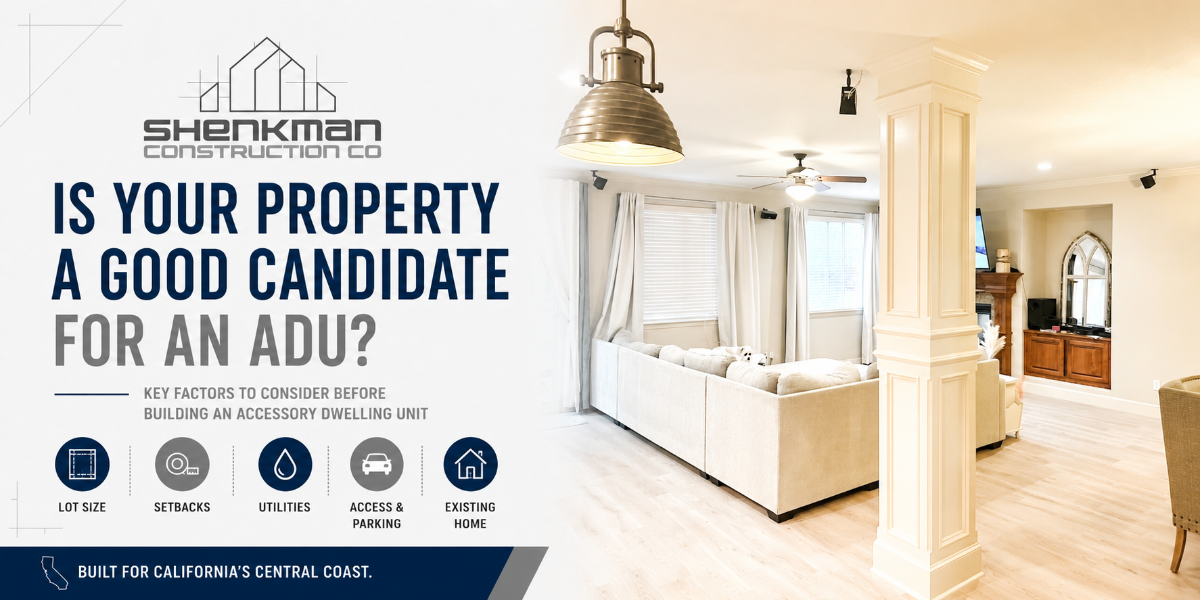
Is Your Property a Good Candidate for an ADU?
Building an Accessory Dwelling Unit (ADU) is one of the most effective ways to add usable living space, accommodate family members, or generate rental income without purchasing another property. However, one of the first questions homeowners ask is whether their property can actually support an ADU.
The good news is that many properties throughout California's Central Coast can accommodate an ADU. The better question isn't simply "Can I build one?" It's "What will it take to build one successfully?" Every lot presents different opportunities and challenges, and understanding those factors early can save significant time, money, and frustration.
At Shenkman Construction Co., we've spent more than seven years helping homeowners evaluate their properties before construction begins. As a family-owned company and licensed California contractor (License #1062694), we help homeowners understand what's possible while developing practical solutions that fit their property, budget, and long-term goals.
Every Property Is Different
Two neighboring homes may appear nearly identical from the street, yet one lot may be much easier to develop than the other.
Property size, slope, utility locations, existing structures, easements, drainage, and local development standards all influence whether an ADU can be built and what construction may be required.
That's why every ADU project begins with evaluating the property itself before discussing floor plans or construction costs.
Lot Size Is Only One Piece of the Puzzle
Many homeowners assume a small lot automatically rules out an ADU, but that's often not the case.
While available space certainly matters, lot size alone rarely determines whether an ADU is feasible. The placement of the existing home, setbacks, utility access, and the overall layout of the property often have a greater impact than the lot's overall dimensions.
Even modest residential lots throughout communities like Nipomo, Arroyo Grande, and Santa Maria may provide opportunities for thoughtfully designed ADUs.
Understanding Setback Requirements
Setbacks establish how close new construction can be to property lines and existing structures.
Although California has made ADU construction easier in many situations, setback requirements may still influence:
-
- Building placement
- Overall ADU size
- Outdoor living space
- Access pathways
- Privacy between structures
Understanding these limitations early helps avoid redesigns later in the planning process.
Existing Structures Affect Your Options
The location of your existing home, garage, patios, sheds, retaining walls, swimming pools, and driveways all influence where an ADU can be constructed.
In some cases, converting an existing garage into an ADU may provide the most efficient use of the property. On other lots, constructing a detached ADU or even considering a home addition may be the better long-term solution.
Looking at the entire property instead of focusing on one available corner usually leads to better design decisions.
Utility Access Is a Major Consideration
Every ADU requires reliable utility connections.
Depending on the property, construction may involve extending or modifying:
-
- Water service
- Sewer or septic connections
- Electrical service
- Natural gas
- Heating and cooling systems
- Internet and communications wiring
The distance between the existing home and the proposed ADU can have a significant impact on construction costs, particularly when trenching or utility upgrades are required.
Shenkman Construction coordinates plumbing and electrical work as part of complete ADU construction projects to ensure these systems are designed properly from the beginning.
Topography Can Influence Construction Costs
Flat lots are generally simpler to build on than sloped properties, but that doesn't mean hillside lots can't accommodate an ADU.
Steeper sites may require:
-
- Additional grading
- Retaining walls
- Engineered foundations
- Drainage improvements
- More extensive excavation
Many properties throughout San Luis Obispo County feature varying elevations, making early site evaluation an important part of the planning process.
Parking Requirements Continue to Evolve
Parking is another topic that generates a lot of questions.
California has relaxed many parking requirements for ADUs, particularly in certain locations and under specific circumstances. However, homeowners should still think about how vehicles will access and use the property after construction is complete.
Even when replacement parking isn't legally required, maintaining good site circulation often improves both functionality and long-term property value.
Older Homes May Require Additional Improvements
Many homes throughout Nipomo, Arroyo Grande, and San Luis Obispo were built decades ago. While these properties often make excellent ADU candidates, they may also require updates before new construction begins.
Depending on the home's age, improvements could include:
-
- Electrical service upgrades
- Plumbing modifications
- Sewer improvements
- Drainage corrections
- Foundation work
Evaluating these systems early allows homeowners to develop more accurate budgets and avoid unexpected surprises during construction.
Local Regulations Still Matter
California has adopted legislation that encourages ADU construction, but local jurisdictions continue to administer permitting, inspections, utility requirements, and site-specific development standards.
Depending on where your property is located, additional considerations may include:
-
- Flood zones
- Coastal regulations
- Fire hazard requirements
- Historic districts
- Utility provider requirements
Understanding these requirements before investing in plans helps projects move more efficiently through the approval process.
Think Beyond Today's Needs
One of the biggest advantages of building an ADU is flexibility.
Many homeowners initially build an ADU for one purpose, only to find it serves an entirely different need a few years later. A rental unit may eventually house aging parents. A guest suite might become a home office. Living space for adult children could later provide supplemental retirement income.
Planning around your future goals, not just your immediate needs, often results in a better long-term investment.
Professional Site Evaluations Save Time
Before selecting floor plans or requesting construction estimates, it's helpful to evaluate the property itself.
A professional site evaluation typically reviews:
-
- Existing structures
- Lot layout
- Utility locations
- Site access
- Topography
- Drainage conditions
- Potential construction challenges
Answering these questions first often prevents expensive design revisions later.
Planning Your ADU Project
At Shenkman Construction Co., we believe successful ADU projects begin long before construction starts. We help homeowners evaluate their property, compare options, understand permitting requirements, and determine whether a detached ADU, garage conversion, or another solution makes the most sense.
Our experience with complete residential construction, including framing, utility coordination, interior finishing, and ADU development allows us to guide homeowners through every stage of the process with realistic expectations.
Proudly Serving California's Central Coast
While this article focuses on homeowners evaluating ADU opportunities in Nipomo, Shenkman Construction Co. proudly designs and builds ADUs throughout California's Central Coast, including:
-
- Nipomo
- Arroyo Grande
- Grover Beach
- Pismo Beach
- San Luis Obispo
- Santa Maria
- Santa Barbara
You can also view our complete service area to learn where we provide ADU construction and home remodeling services.
Wondering if Your Property Can Support an ADU?
The best way to find out is with a professional property evaluation. We'll review your lot, discuss your goals, identify potential challenges, and explain the options available for creating an ADU that fits your property and your long-term plans.